"It happens that in being with children we will sense the presence of a force, mysterious and silent, which does not belong to us, and we will treasure it as an inestimable privilege to be granted at times to 'see' it working within the child. As Elijah did on Mount Horeb when he heard the 'tiny, whispering sound,' at moments like this we too will want to 'cover our face' in beholding the presence of God (1 Kings 19:13)" ~ Sofia Cavalletti "And a little child shall lead them..." in Journals of the Catechesis of the Good Shepherd 1984-1997 p. 167
Last week in the Level 3 atrium, a group of children worked on the Memorial as I watched. One child stated that the outlines on the workspace reminded him of a sword. Later on as he worked with the materials, I sensed that he was being drawn into the work. At one point, he looked at their completed project and softly said "It looks like the Kingdom of God."
This child is normally not particularly reflective, but in this instance, the Good Shepherd tugged at his heart, showing him past, present and future reflected in the Eucharistic meal and I was privileged to be there. Thank you Jesus!
Beate

Thursday, December 18, 2014

Sunday, November 30, 2014
Beginning a New Liturgical Year
The liturgical calendar helps us to orient ourselves into God's time.

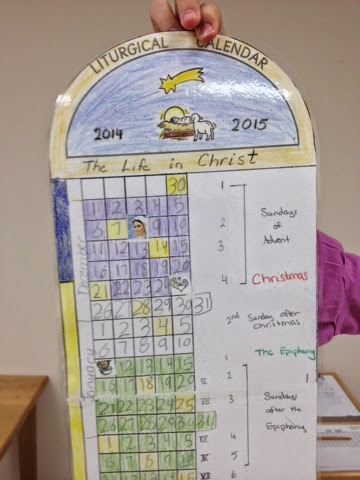
This is the Level 3 liturgical calendar, a long work in more than one way. The children start by figuring out when the first Sunday of Advent is and start numbering their pages. They know there are always 4 Sundays of Advent and 3 Sundays of Christmas. Next they find the date of Easter by looking at the lunar cycles. Even though our lives are vastly different from those of our ancestors, seasons are still determined by the sun and the moon. Passover is determined by those seasons, as is the great feast of Easter.
In article 1170 of the Catechism we read: "At the Council of Nicaea in 325, all the Churches agreed that Easter, the Christian Passover, should be celebrated on the Sunday following the first full moon (14 Nisan) after the vernal equinox."
Together we discuss that the vernal equinox is on March 21 and from there the children look at lunar calendars to find out when the first full moon after that date occurs and determine the date of Easter. The children have worked with a wooden liturgical calendar since the Level 1 atrium so they know the set numbers of Sundays in the Lent and Easter seasons. Once the date of Easter has been determined, the periods of ordinary time can be filled in.
Thursday, November 20, 2014
Parables..
From the CGS National July newsletter for parents:
A Word About Parables: When we are in the Atrium with the children, we announce the parable, meditate with the children and wonder with them about the words of Jesus. We allow the child to work with the materials as part of their own meditation, as well as time for silence, prayer or song. The most difficult thing for us to do as adults is to simply stop and be still. We do not want to put ourselves between the Word of God and the child. In parables, we let the scripture do the teaching. We do not tell the children how to interpret parables, offer definitions of the parable, as no one formula or definition speaks to everyone at the same time.
When this methodology was in its infancy, Sofia sometimes referred to it as the 'Parable method.' Until I began my own formation, I certainly did not comprehend the depth and value of this manner of teaching. In college, I appreciated the 'just the facts' type profs, although if I look back, I admit I learned much more as I went down various rabbit trails based on the snippets of information I was given in class.
Notes I took during my first CGS formation more than a decade ago:
A parable offers images that help us to penetrate mysteries too deep to communicate in definitions, too rich to capture in just one definition. There is no single interpretation, making them accessible to everyone. Parables leave listeners with a sense of wonder and help us to see the splendor in the ordinary – help us to see through this world into the mystery that lies behind it. Listeners are invited to search together for
the meaning – the line between student and teacher is erased as we become
co-wonderers.
Cavalletti says “The use of a definition betrays the reality that
God is unfathomable.” While a parable is
the beginning of a conversation, a definition is a closed door. Definitions do not stir any interior
reflection or work in the child, instead giving a finished product and failing to draw the child into the process. Parables help us enter into mysteries too
deep to describe with mere definitions.
“Explanation is like the pin that immobilizes the
butterfly.” Sofia
As an adult, I'm privileged to share scripture both with other adults and with children. I think what has caught me most unaware, is the living aspect of the word of God. Every single time I encounter Christ through scripure He has something new to say to me. What a lovely gift that is!

Here are two of the parables we share with the children - can you see the tiny mustard seed that is lying on the card?

Wednesday, November 19, 2014
November Update from the Atria
Our atria are bursting at the seams, especially Level 2! It is a joy to see Catechesis of the Good Shepherd embraced by the community. In fact, we've grown so much that it became necessary to open another time slot. Last month, we began meeting on Thursday afternoons between 4:30 and 6:00. We have a small group of children in all the levels, which makes for a peace-filled afternoon.
One little boy comes on Sundays and Thursdays, which has really helped him to enter deeply into the work. Last week he was pondering the Parable of the Leaven and chose to make two batches of dough, one with yeast and one without. At the end of the period, he contemplated the results with the catechist: "Look, it really is like the Kingdom of Heaven!" he exclaimed with delight and surprise. This little four year old has managed to reveal a bit of Heaven to the rest of us with his joy and acceptance.
The level 2 children have been revisiting the gestures of the Mass that are presented in Level 1 and placing them into the rite of the Mass. It's interesting to see the children's appreciation for the innate order of our liturgical life. The Thursday group is mostly new to the atrium, so now that we've looked at the big picture, we'll break it down into the moments. I'm looking forward to sharing the mingling of the water and wine with this group.
In Level 3, we've been unpacking moments of the Mass. Last Sunday a group of children worked with the Memorial, which traces the Eucharistic celebration from the Last Supper to today and into Parousia. Eventually, we'll study Exodus and trace those roots back even further. One student, new to the Church, was amazed to hear the prayers we looked at in class later on during Mass. It's a gift for the children to recognize the power of the words that we adults often just allow to wash over us without too much notice.

In Level 3, we've been unpacking moments of the Mass. Last Sunday a group of children worked with the Memorial, which traces the Eucharistic celebration from the Last Supper to today and into Parousia. Eventually, we'll study Exodus and trace those roots back even further. One student, new to the Church, was amazed to hear the prayers we looked at in class later on during Mass. It's a gift for the children to recognize the power of the words that we adults often just allow to wash over us without too much notice.
This is my work from yesterday - I wanted to meditate on the memorial it a bit. The words of Christ are on small cards which are moved down through the ages - it's hard to see on the phone photo. I'll have to bring the camera to work at some point.
You can see the Structure of the Mass chart behind the Cenacle (or Last Supper) work, not because that's where it belongs, but because a child left it out on Sunday in order to finish the work the next week :-)
~ Beate
You can see the Structure of the Mass chart behind the Cenacle (or Last Supper) work, not because that's where it belongs, but because a child left it out on Sunday in order to finish the work the next week :-)
~ Beate
Saturday, September 20, 2014
Welcome Once Again!
I'm so happy to see many new and returning faces in our atria this year. My goal was to write out an nice orientation for you, but alas, time has once again slipped away from me so I'm linking to a blog post by fellow catechist Mandie DeVries in which she summarizes Catechesis of the Good Shepherd and compares it with the traditional education most of us received.
http://allsaintscgs.blogspot.com/2010/09/parent-orientation-in-sum.html
Please feel free to call, text or email me if you have any questions or concerns.
Beate
http://allsaintscgs.blogspot.com/2010/09/parent-orientation-in-sum.html
Please feel free to call, text or email me if you have any questions or concerns.
Beate
Tuesday, August 26, 2014
Busy getting ready
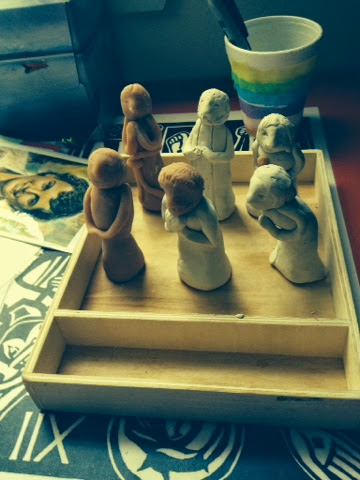
Below are 6 little apostles, baked and waiting to be painted.
Thursday, June 26, 2014
Video Introduction of the Catechesis of the Good Shepherd
The quote below is from an older video no longer available, but is still resonates :-)
"We just believe in this so much that we're willing to drive 30 miles, one way, to make sure that our children are getting the fullness of their faith."
This resonated with me, since I've been driving to one atria or another for the past 11 years! None of them were less than 20 miles away, but it's been such a beautiful journey.
"We just believe in this so much that we're willing to drive 30 miles, one way, to make sure that our children are getting the fullness of their faith."
This resonated with me, since I've been driving to one atria or another for the past 11 years! None of them were less than 20 miles away, but it's been such a beautiful journey.
Subscribe to:
Posts (Atom)